Maintaining chemical consistency across a large batch of soap is one of the most persistent challenges in industrial chemistry. When solid residues or unreacted raw materials remain in the soap mass, the result is often an uneven texture that fails to meet consumer standards for smoothness and professional appearance.
The transition from artisanal batches to a high-capacity soap making production line requires more than just larger tanks; it demands precise filtration and mixing mechanisms to ensure that the final product remains homogenous. Without integrated filtration, the risks of clumping and chemical instability increase, potentially damaging downstream equipment.
This technical overview examines the critical role of filtration and refined mixing in modern soap manufacturing, detailing how specific hardware configurations prevent impurities and optimize the overall efficiency of the production flow.


Within the saponification pot, the filter cylinder acts as the primary gatekeeper of quality. Its main function is to ensure that the soap mass remains free of solid residues and unreacted raw materials. If these particles persist, they can interfere with the core chemical reactions, leading to unstable batches and an uneven final texture.
By capturing these contaminants early in the process, manufacturers can avoid the costly necessity of re-processing entire lots. This initial filtration step is foundational to any high-standard soap production line, as it dictates the purity level of the base material before it enters the refining stages.
The removal of impurities occurs across multiple stages, most notably within the mixing cylinder. Here, specialized equipment helps maintain smooth blending by capturing microscopic impurities and preventing the formation of clumps. This process is not merely about cleanliness; it is about managing the rheology of the soap mass to ensure it flows correctly through the rest of the line.
Effective mixing combined with filtration ensures that additives—such as fragrances or dyes—are distributed uniformly. When clumping is prevented, the mechanical stress on the equipment is reduced, extending the lifespan of the motors and seals used in the mixing and conveying stages.
Integrating these filtration points at different stages of production creates a multi-layered defense. This systemic approach ensures that any residue that might have bypassed the saponification pot is caught during the blending phase, guaranteeing that only a refined, smooth mass proceeds to extrusion.
The efficiency of downstream processes—specifically extrusion, drying, and stamping—is directly dependent on the quality of the soap mass delivered to them. When the mass is free of clumps and residues, the extrusion pressure remains constant, and the stamping process produces sharper, more professional edges.
The integration of filter cylinders and mixing purification units reduces mechanical downtime by preventing blockages in the extrusion head and ensuring a linear flow of material.
For manufacturers operating at scale, this means a higher throughput and a lower rejection rate. By stabilizing the material flow, the energy consumption of the conveyor systems and plungers is optimized, as the machinery does not have to struggle against inconsistent densities in the soap mass.
The perceived quality of a soap product is heavily tied to its "skin feel" and visual uniformity. Professional-grade soaps require a level of smoothness that can only be achieved through rigorous filtration. When residues are eliminated, the resulting soap lacks the grainy texture often associated with lower-quality industrial products.
This uniformity is essential for both industrial-use soap and consumer-focused luxury products. A consistent texture ensures that the soap wears evenly during use and maintains its structural integrity during the drying process, preventing premature cracking or warping.
In a typical industrial setting, the integration of these components varies based on the target product. For example, a manufacturer producing translucent soaps requires a higher degree of filtration to ensure that no opaque residues interfere with the visual clarity of the bar. In these scenarios, the filter cylinder must be paired with high-precision refining machines.
Conversely, for mass-market laundry soaps, the focus is often on high-volume throughput. Here, the priority is preventing large clumps that could stall the conveyor or jam the electronic dicing machines. Shijiazhuang Ruisheng Machinery Manufacturing Co., Ltd. provides customized solutions for these varying needs, integrating vacuum double-drawing machines and sigma kneaders to balance purity with production speed.
The industry is moving away from single-point filtration toward holistic "clean-flow" architectures. This shift is driven by the need for higher repeatability and reduced waste. Modern lines now incorporate intelligent monitoring to detect pressure drops across filters, allowing for maintenance before a total blockage occurs.
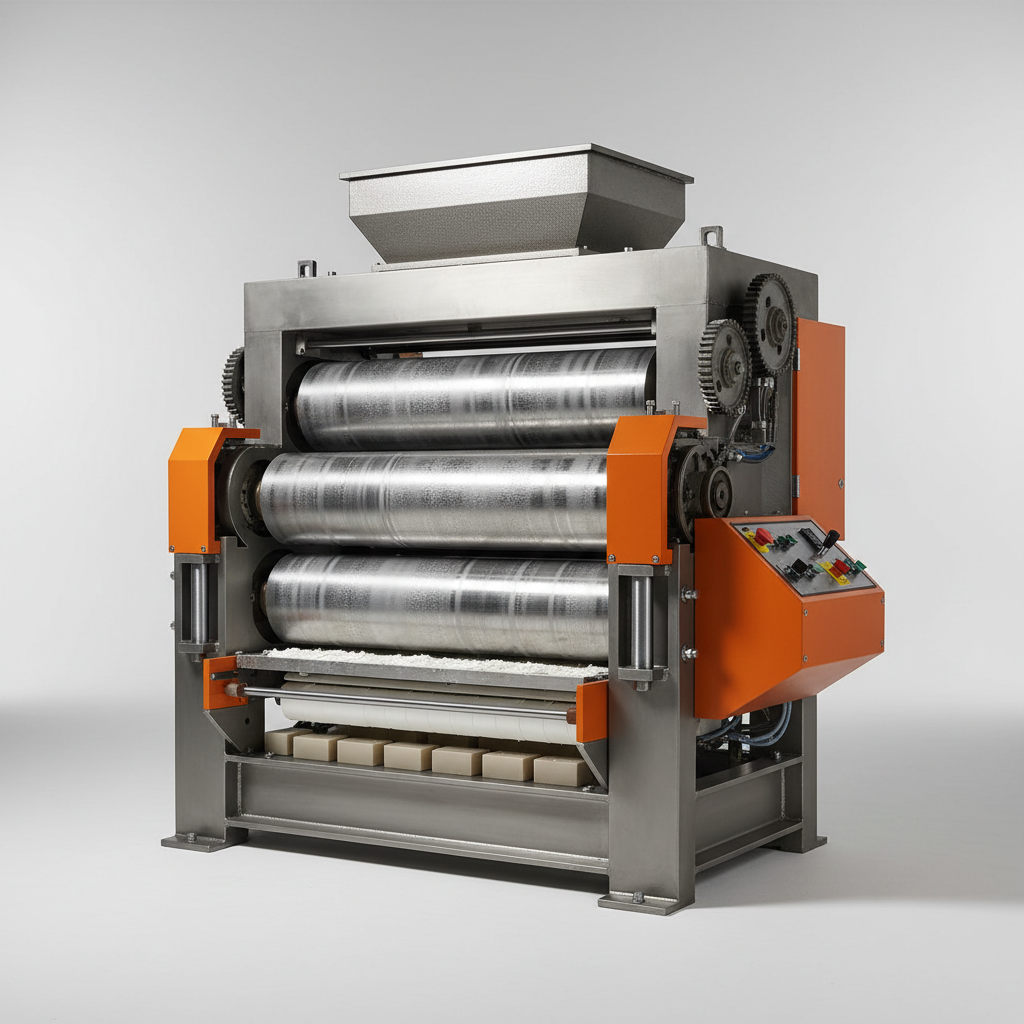
Another significant trend is the adoption of advanced three-roll grinders and soap refining machines that work in tandem with the initial filter cylinders. This combination ensures that the soap mass is not only free of impurities but also mechanically homogenized to a molecular level, which is critical for the longevity of the product's shelf life.
As sustainability becomes a priority, the focus is shifting toward reducing the raw material waste generated during the filtration process. Improved filter designs allow for easier recovery of captured residues, which can sometimes be repurposed or re-processed, thereby increasing the overall yield of the production line.
Selecting the right components for a soap making production line requires a trade-off analysis between purity requirements and operational costs. A manufacturer must decide where the most critical filtration points are located based on their specific raw material quality and final product specifications.
Key considerations include the material of the filter cylinders (usually high-grade stainless steel to prevent corrosion from caustic soap mass) and the ease of cleaning. In high-output environments, the ability to swap filters quickly without halting the entire line is a significant operational advantage.
The following framework provides a relative assessment of different filtration strategies based on typical industry requirements for texture, throughput, and maintenance.
| Strategy | Texture Quality | Throughput Impact | Maintenance Load | Ideal Use Case |
|---|---|---|---|---|
| Single Pot Filter | Moderate | Low | Low | Basic Utility Soap |
| Dual-Stage Mixing | High | Moderate | Medium | Standard Toilet Soap |
| Integrated Refining | Very High | Moderate | High | Premium Cosmetic Soap |
| Multi-Point System | Exceptional | Low/Consistent | Medium | Specialized Transparent Soap |
| Bypass-Enabled Line | High | Very High | Low | High-Volume Industrial |
| Customized Hybrid | Variable | Optimized | Variable | Niche/Artisan Scale |
If the filter cylinder fails or is bypassed, unreacted raw materials and solid residues enter the soap mass. This typically results in an uneven, grainy texture and can cause chemical instabilities that affect the soap's lathering properties. More critically, these residues can travel downstream and cause blockages in the extrusion machinery, leading to unplanned downtime and potential equipment damage.
Pot filtration occurs during the initial chemical reaction to remove bulk residues. Mixing cylinder filtration is a refining step that captures smaller impurities and prevents the formation of clumps during the blending of additives. While pot filtration ensures chemical purity, mixing filtration ensures physical homogeneity and smoothness, which is essential for the final professional appearance of the soap.
While the filter cylinder is vital, the combination of a soap refining machine and a three-roll grinder is most critical for achieving an ultra-smooth texture. These machines mechanically break down any remaining particles and ensure the soap mass is completely homogenized. When integrated into a full production line, they transform the basic filtered mass into a high-quality, consumer-ready product.
Yes, many lines can be upgraded by integrating additional filtration units at strategic points, such as between the mixer and the extruder. Adding a dedicated refining stage or upgrading the existing filter cylinders to higher-precision meshes can significantly improve product quality without requiring a complete overhaul of the primary saponification and molding equipment.
Consumer soaps, especially cosmetic grades, require extreme filtration to ensure a flawless aesthetic and skin-feel. Industrial soaps may tolerate a slightly higher level of residue, but they prioritize filtration that prevents large clumps which could interfere with high-speed automatic stamping and dicing. The focus for industrial lines is often more on throughput stability than microscopic smoothness.
Clumping is usually caused by improper temperature control during the mixing phase or the presence of unreacted raw materials that create "nuclei" for clumps to form. Effective mixing cylinders with integrated impurity capture mechanisms help mitigate this by ensuring a smooth blend and removing the particles that trigger clumping, allowing for efficient extrusion and stamping.
The difference between a mediocre soap product and a professional-grade one lies in the invisible details of the production process. By prioritizing rigorous filtration within the saponification and mixing stages, manufacturers can ensure a level of uniformity and smoothness that defines market leadership.
As the industry evolves, the integration of high-precision refining machinery and intelligent filtration systems will continue to be the primary driver of efficiency and quality. Investing in a well-engineered soap making production line is not just about increasing volume, but about mastering the consistency of every single bar produced.